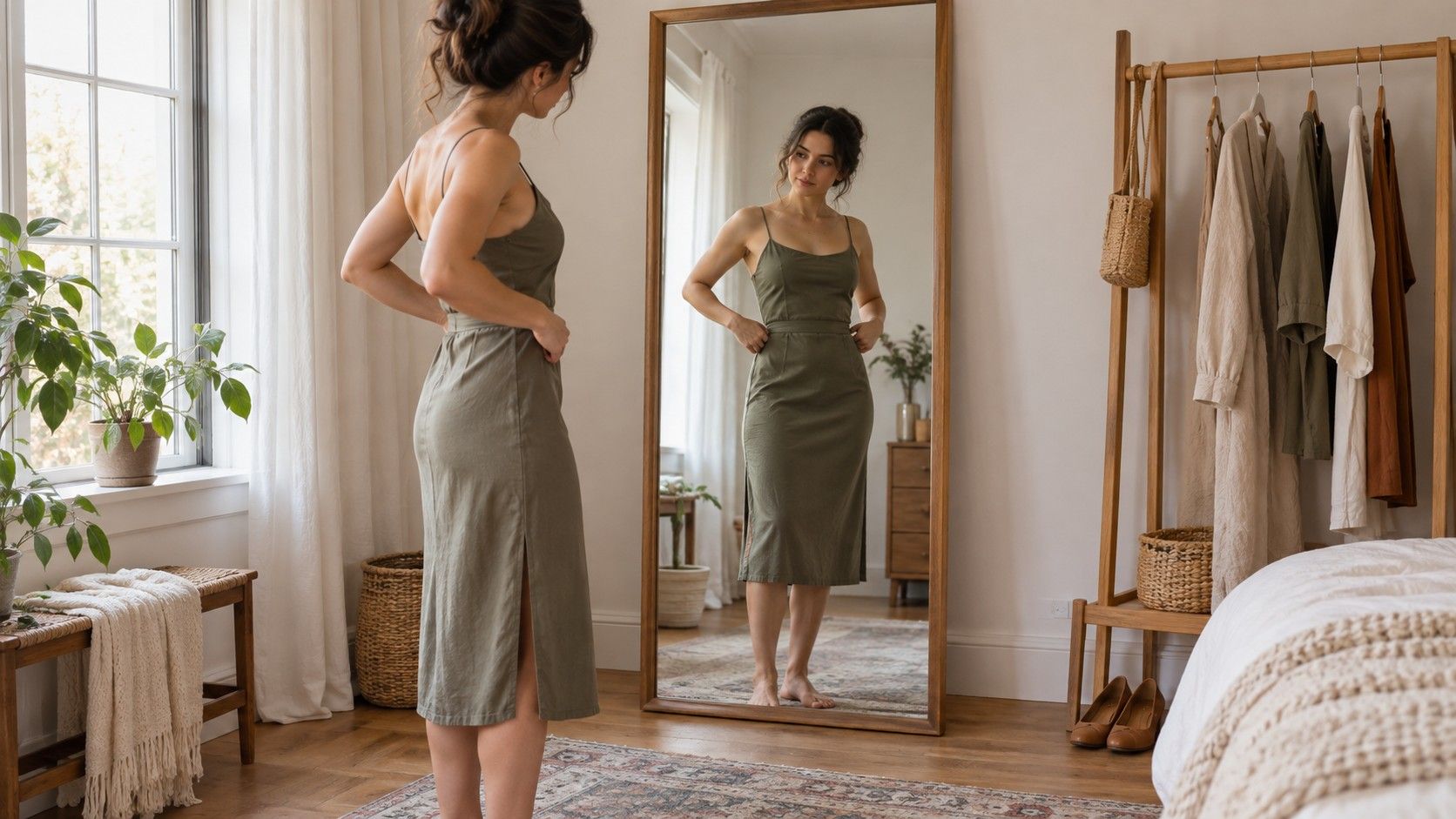
A useful capsule wardrobe is not the smallest possible rail of clothes, and it does not need to follow a list written for an hourglass, pear, rectangle, or any other label. It is a set of pieces that cooperate with the proportions you notice on your own body and with the way you actually dress. The most reliable starting point is therefore not a shopping list. It is a few honest fit notes taken from outfits you already reach for, including what shifts, pinches, bunches, or simply feels easy after several hours.
Why a proportion-led capsule stays flexible
Most capsule formulas begin with quantities: two trousers, three tops, one jacket, perhaps a dress. That arithmetic looks tidy but says nothing about whether the jacket works with the rise of the trousers or whether all three tops end at an awkward point beneath it. A proportion-led capsule asks a different question: which combinations create the amount of length, definition, and ease that you enjoy? The answer may involve a cropped outer layer over a longer column, a tucked knit with a higher rise, or an untucked shirt that clears the fullest part of the hip. None of those choices is a correction. They are practical relationships between garments.
This approach also survives changes better than a rigid wardrobe for body type. Weight can fluctuate, posture can change, and personal taste rarely stays fixed for years. Garment proportions remain observable. You can notice that a 58-centimetre jacket works with most of your trousers, while a longer blazer needs a narrower or straighter layer underneath. You can learn that shoulder seams matter more to you than waist definition, or that the swing of a fabric matters more than its printed size. Those notes still help when a body-shape label feels uncertain or stops being useful.
A capsule wardrobe body shape search often promises a flattering answer for every item. Real life is less absolute. The same wide-leg trousers may feel composed with a close-fitting top on Monday and relaxed with an oversized shirt on Saturday. Occasion, shoes, temperature, and movement alter the picture. Treat proportions as adjustable settings rather than rules and the capsule can support both versions instead of forcing one approved silhouette.
Write fit notes from clothes you already wear
Set aside three outfits you wear repeatedly and two that look promising on the hanger but stay at the back of the wardrobe. Put each one on with the underwear and shoes you would normally choose. Then move: sit at a table, reach overhead, walk up stairs, and place a phone or wallet in the pockets. A mirror shows the front view; movement reveals whether a waistband rolls, a shirt escapes its tuck, or a sleeve prevents you from lifting your arms. These are more useful facts than a general verdict such as flattering or unflattering.
Write observations in garment language. Instead of “my hips are the problem,” note “this rigid hem catches at the hip when I sit.” Replace “I cannot wear cropped jackets” with “this jacket and low-rise trouser leave a gap I dislike; it works with my higher-rise pair.” That small change keeps the body out of the blame and gives you something you can test. It also identifies straightforward tailoring jobs. A waist that gaps while the seat fits may be worth altering; a jacket that is tight across both shoulders and upper arms is usually a poor candidate.
| What you notice | Useful fit note | Next test |
|---|---|---|
| A top bunches above the waistband | Too much length or fabric for this rise | Try a shorter top, a higher rise, or a deliberate full tuck |
| A layer feels heavy through the middle | Outer and inner hems end at the same point | Separate the lengths or reduce bulk underneath |
| Trousers look right but stay unworn | Shoes or seated comfort may be the obstacle | Test the intended shoes and sit for ten minutes |
| A dress needs constant adjustment | Straps, neckline, or waist placement moves | Assess alteration cost before keeping it |
Photographs can help, but take them for comparison rather than judgment. Use the same camera height and a relaxed stance, then look at garment lines: where hems stop, whether a lapel lies flat, and how the outfit changes with a different shoe. A side view is especially useful for jackets and untucked tops because it shows fabric pooling that a front-facing mirror hides.
Choose repeatable top, bottom, and layer combinations
Once the notes reveal two or three reliable relationships, build around them. You might discover that high-rise straight trousers pair easily with tops that finish at the waistband, while mid-rise jeans work better with soft shirts worn open over a fitted base. Those are core silhouettes: not uniforms, but repeatable frameworks. A practical body shape wardrobe usually needs only a few frameworks that share pieces. If one cardigan works solely with one dress and no other bottom, it is a special outfit piece rather than capsule infrastructure.
Lay possible combinations on a bed or use hangers side by side. Check the overlap between top and waistband, the bulk under a layer, and whether the coat covers or fights the jacket beneath it. Then try the full outfit. A fine knit that looks compact alone may gather under a fitted blazer, while a substantial T-shirt may keep its line better. Fabric changes apparent proportion: crisp cotton holds space, ribbed jersey follows the body, and a fluid weave collapses closer to it. Two tops with identical measurements can therefore play very different roles.
Layering lengths deserve their own note because they cause many quiet failures. If every shirt extends below every jacket by only two centimetres, the result may look accidental and require repeated tugging. Either make the separation clear or choose hems that align cleanly. The same reasoning applies to coats over midi skirts and dresses. There is no universal correct pairing; the useful choice is the one that stays intentional when you walk and sit, not only when everything has been arranged for a photograph.
Shoes alter both comfort and the visual weight at the bottom of an outfit. Before declaring a trouser difficult, try the shoes it was meant to meet. Hem length, toe shape, sole thickness, and the amount of exposed ankle can change how the whole combination reads. If a capsule depends on shoes you cannot comfortably wear for the relevant day, it is not functioning, however polished the mirror image may be.
Leave room for trends without losing usefulness
A capsule does not have to be neutral, timeless, or immune to fashion. It only needs a stable centre. Trend pieces are easiest to integrate when you identify which variable they change. A dramatic sleeve adds volume under jackets; a very low rise changes the top lengths that work with it; a sheer skirt may require an extra layer; a bulky shoe changes trouser hems. Knowing the consequence lets you decide whether the experiment fits the rest of the wardrobe instead of dismissing it because a body type fashion rule says no.
Use a two-outfit threshold as a practical check, not a moral standard. Before buying, name two complete outfits using garments already at home, including shoes and an outer layer if the season requires one. If you can name only a fantasy combination that needs three more purchases, pause. The item may still be worth having, but it should be recognised as a project or occasion piece rather than sold to yourself as a capsule essential.
This is also where return decisions become clearer. Keep the tags on and repeat the movement check in daylight. Test the item with the exact underwear and layers it needs. If it requires constant smoothing, a heel you avoid, or tailoring you are unlikely to book, the friction will not disappear once the return window closes. Returning a poor partnership is not failing to dress your proportions; it is protecting the usefulness of the clothes that already work.
Review the capsule after real-life wear
A wardrobe cannot be evaluated from a perfectly arranged rail. Give the working set two or three ordinary weeks, then review what happened. Which top was unavailable because it was always in the laundry? Which trousers handled sitting, commuting, and dinner without negotiation? Which layer stayed home because the sleeves were too tight over knitwear? Outfit repeats provide evidence. They show the combinations that earn their space and the apparent gaps that are really laundry, weather, or styling problems.
Keep the review short: “wore often,” “works only with,” “needs alteration,” “wrong season,” or “does not suit my day.” A garment that works only with one pair of trousers is not automatically a mistake if you love that combination and wear it. Conversely, a theoretically versatile shirt is not useful if its collar irritates your neck. Capsule thinking should reduce daily effort, not turn ownership into a performance of efficiency.
When a gap is real, describe the job before searching for the item. “A light layer” is vague; “a washable layer that closes comfortably over my work shirts, ends above the widest part of these trousers, and fits under my raincoat” is actionable. Bring the relevant measurements and, if possible, wear one of the intended base outfits while trying options. This is how to build wardrobe for proportions without letting the process become another reason to shop indiscriminately.
Finally, allow the capsule to remain unfinished. Bodies, schedules, and tastes shift, and the most dependable wardrobe records those changes rather than resisting them. Fit notes turn each wear into modest information: a hem that works, a fabric that annoys, a proportion you want to repeat. Over time, those observations create a capsule that looks coherent because it belongs to one life, not because it obeys a universal diagram.