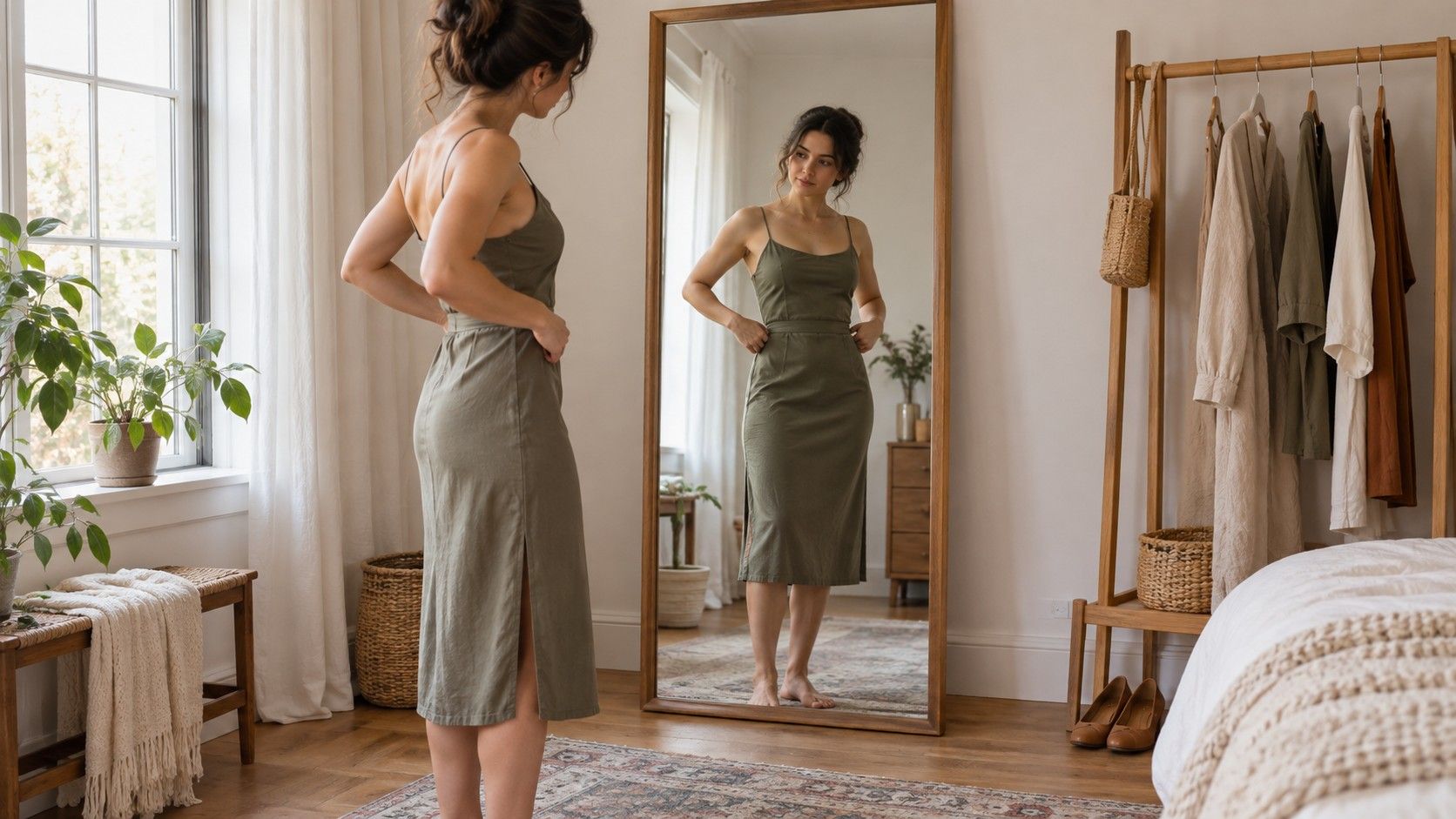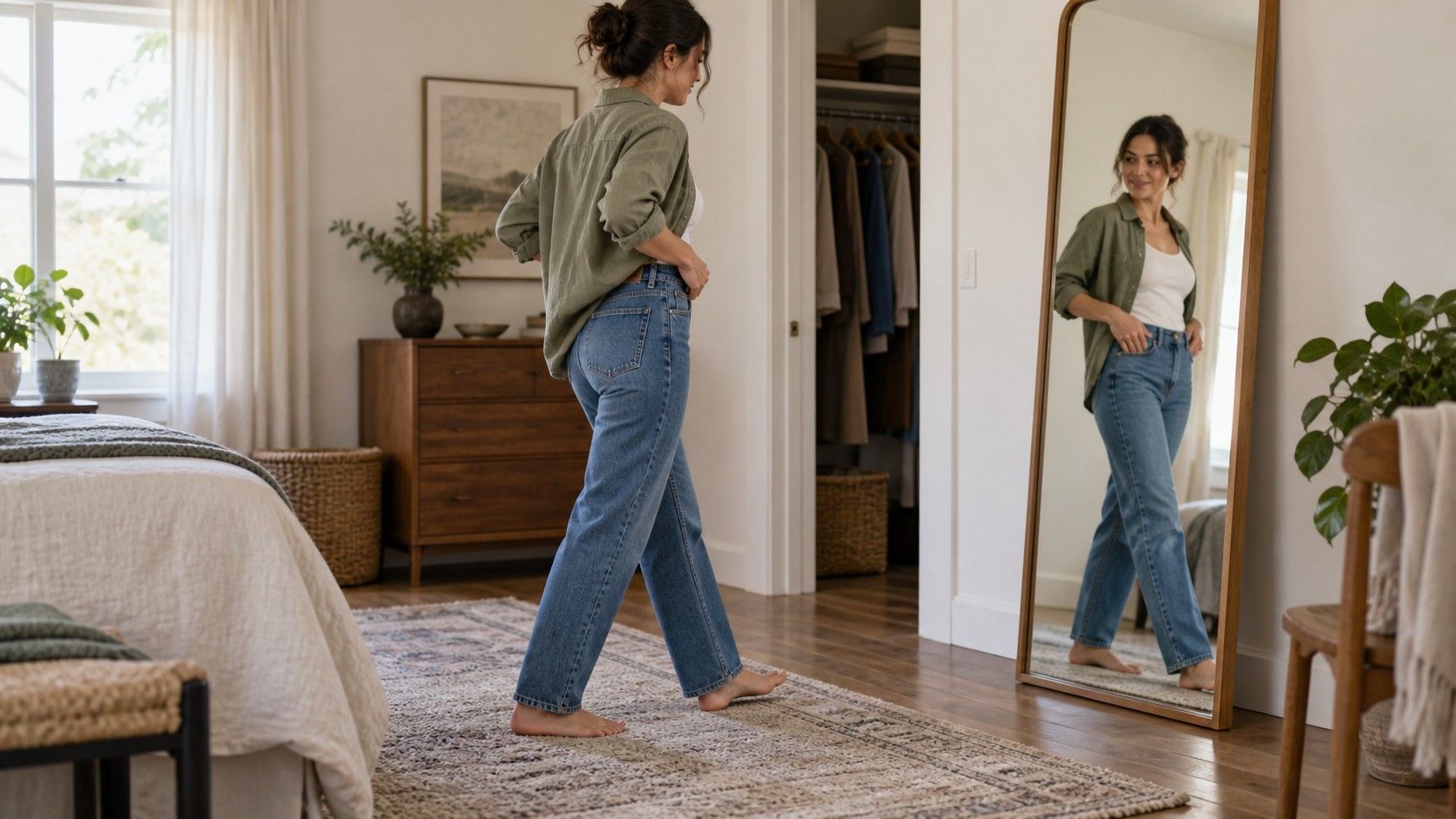
Searching for jeans for body shape can point you toward a few cuts, but the label does not explain why a waistband gaps, a front rise folds, or pockets pull across the seat. Jeans are a structured garment with several measurements working at once. The most reliable starting point is a pair you already wear: measure its rise and waist, notice where it sits, and compare how the hip, seat, and thigh behave after movement. Those details lead to a more repeatable fit than a category name.
Why body shape is only one part of jean fit
Two people with similar waist and hip circumferences can need different jeans because their proportions are distributed differently. One may have more depth through the seat, while the other carries more width at the side hip. Pelvic tilt, torso length, thigh circumference, and preferred waistband position also affect the fit. A body-shape description cannot capture all of those variables, and a flat size chart usually lists only part of them.
The jeans pattern matters just as much. Front rise and back rise are not necessarily equal, and the curve joining them determines room through the crotch and seat. A contoured waistband is shaped to narrow toward its top edge; a straight waistband behaves more like a firm band. Pocket bags, fly length, yoke angle, and seam placement can change how the same labeled size feels.
This is why the best jean rise for body type is not a universal high, mid, or low answer. A high rise can feel secure on one torso and press into the ribs on another. A mid rise may sit comfortably through a long day or may land at a point where the waistband rolls. Rise is useful when expressed as an actual measurement and a position on your body, then tested for sitting and bending.
Measure the rise on jeans you already own
Choose one pair that stays in place and another that gives you a recurring problem. Fasten each pair, lay it flat, and smooth the fabric without stretching it. Measure the front rise from the crotch seam intersection to the top edge of the front waistband. Measure the back rise from the same intersection to the top edge at center back. Follow the curve of the seam with a flexible tape rather than drawing a straight line.
Record the waistband width laid flat, then double it for an approximate circumference. If the waistband is strongly contoured, measure both the top edge and the seam where it joins the jeans; those numbers can differ. Measure the hip straight across at a consistent distance below the waistband, often around 18 to 23 centimeters depending on size and rise. The exact location matters less than using the same method when comparing pairs.
Add the inseam, thigh width, and leg opening if you are trying to reproduce the whole fit. For the thigh, measure straight across just below the crotch. Note the fiber content as well: rigid cotton denim and a blend with elastane cannot be compared by dimensions alone. A worn stretch pair may measure larger than it did when new, so label the notes with its age and whether it has just been washed.
Now connect the numbers to a body position. Put on the comfortable pair and mark where the top edge sits relative to your navel and hip bones. A front rise of 28 centimeters may reach different points on different torsos. When shopping online, compare the listed garment rise with this known pair rather than relying only on the retailer's words high-rise or mid-rise.
Check the waist, hip, crotch, and seat together
A useful jeans hip fit has enough room for movement without depending entirely on stretch. Stand normally and look at the side seams: they should remain reasonably close to the sides rather than swinging toward the front or back. Horizontal strain lines across the front hip or seat suggest tension, while deep folds under the seat can indicate excess length, excess room, or a rise curve that does not match your shape. One wrinkle alone is not a diagnosis; compare what happens when you move.
| Fit signal | Possible cause | Next comparison |
|---|---|---|
| Gap at center back | Waistband is too straight relative to waist and hip | Try a contoured waistband or a cut with a larger waist-to-hip difference |
| Front rise folds sharply | Too much front-rise length, excess room, or fabric collapsing | Compare a slightly shorter rise in a similar denim weight |
| Waistband pulls down when sitting | Back rise or seat depth may be insufficient | Compare a longer back rise and perform the same sitting test |
| Pockets flare or side seams pull forward | Not enough room through hip, abdomen, or pocket area | Size or cut for the fuller area, then assess the waistband |
| Fabric bags below the seat | Rise curve, thigh shape, or excess ease may differ | Compare another cut before simply sizing down |
To answer how should jeans fit hips, check contact without pinching. You should be able to sit fully, climb a step, and place a hand in a functional front pocket if the design includes one. The waistband should not need a belt to prevent the entire garment from sliding, although wearing a belt by preference is different. A small waist gap can often be altered, while severe pulling through the hip usually means there is not enough fabric where it is needed.
Check the crotch seam from the side. If it pulls forward or feels tight while the hip looks roomy, the issue may be the rise curve rather than overall size. If the back waistband dips and the center-back seam feels strained when seated, more back rise or seat depth may help. Changing size alters every measurement, so compare the problem area after each change instead of assuming larger or smaller is automatically better.
Pocket placement changes appearance but can also reveal tension. Back pockets should lie flat enough for the intended design and move with the denim rather than spreading sharply at their edges. Very small, high, low, or widely spaced pockets create different visual effects, yet preference is personal. First confirm that the seat has enough ease; then choose the pocket position you like.
See what stretch denim does after an hour
Stretch denim often feels firm in the fitting room and relaxes with heat and movement. Check the fiber label for elastane, spandex, or another elastic fiber, but remember that percentage is only a clue. Fabric weight, weave, finishing, and recovery determine whether jeans soften slightly or grow noticeably. Two blends with the same elastane percentage may behave very differently.
Keep a new pair on for at least ten to fifteen minutes in the fitting room if store policy and time allow. Sit, bend, walk, and warm the fabric. Watch the knees, upper thigh, seat, and waistband. If the jeans become comfortable without losing position, the initial firmness may be appropriate. If the waistband slides and fabric pools at the crotch within minutes, the pair may continue to loosen during a longer wear.
At home, evaluate a pair over one or two normal wears before removing tags when returns allow it. Do not test only by standing. Work at a desk, climb stairs, and put on shoes. Record whether the waistband presses after a meal, whether the knees bag, and whether the seat recovers overnight. The useful question is not simply whether denim stretches, but whether it returns close to its original shape.
Rigid denim has its own adjustment period. It may soften at flex points and mold slightly without the elastic expansion of stretch denim. Buy for a wearable current fit, not a dramatic promised transformation. If breathing, sitting, or circulation is restricted in the shop, future softening is not a dependable fitting plan.
Choose a cut for movement and daily use
Begin with the day you are dressing for. Someone who sits for long periods may prioritize a waistband that does not press at the front and a back rise that maintains coverage. Cycling or walking calls for thigh and knee room. A straight, wide, bootcut, tapered, or slim leg can all work when the top block fits; the choice changes movement, shoe balance, and the amount of fabric around the leg.
Use the comfortable-pair measurements as a filter, then allow a sensible range for fabric. A rigid pair may need more garment ease than a highly flexible pair. Compare the rise first, then the waistband and hip, then the thigh. Inseam can often be altered more easily than the rise or seat curve, so do not reject an otherwise good top-block fit only because the leg is long.
When a waist gap appears, fit the hip and seat before deciding on alteration. A tailor can often reduce a waistband within reasonable limits, but adding room through strained denim is harder. Conversely, sizing up is not always the right answer if it makes the crotch and thigh excessively loose. A different cut with a more suitable waist-to-hip relationship may solve both areas with less compromise.
Keep a compact record on your phone: front rise, back rise, waistband, hip, thigh, inseam, fabric content, size, and one sentence about wear. After a few pairs, you will know whether you repeatedly need a longer back rise, a softer waistband, more seat ease, or less stretch. That personal pattern is a better shopping tool than any fixed list of jeans assigned to a body shape, and it remains useful across brands whose size labels have little in common.