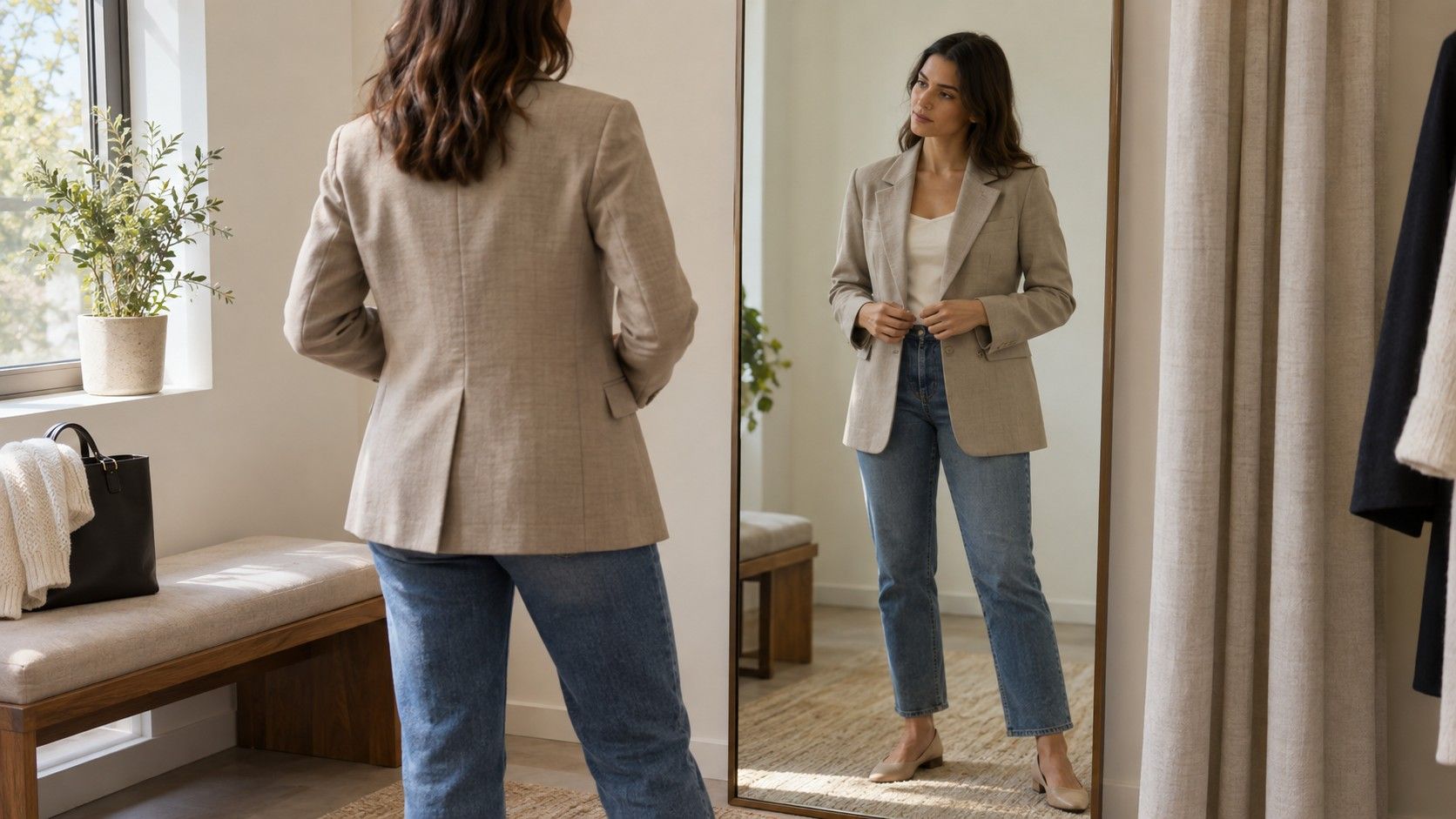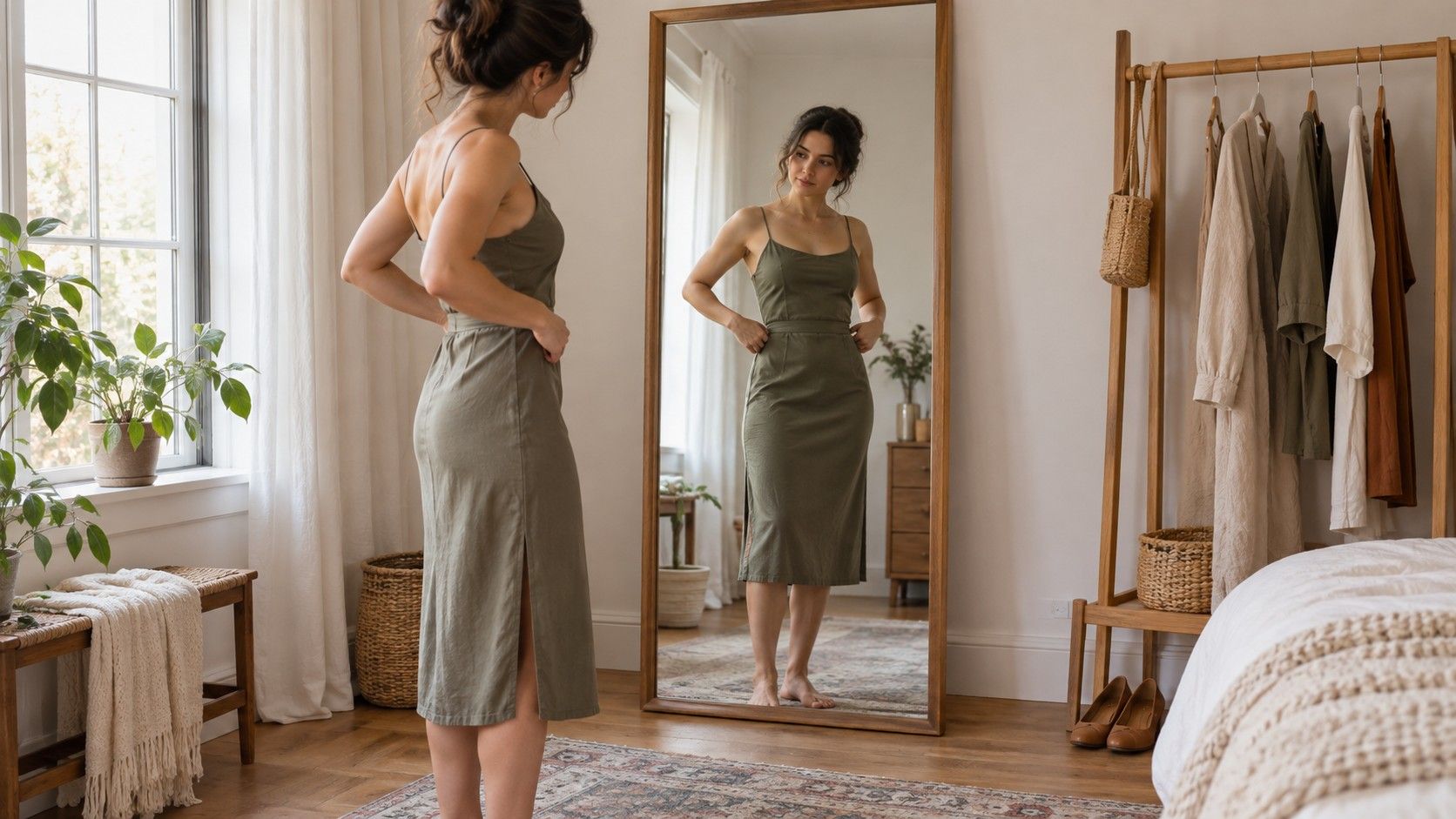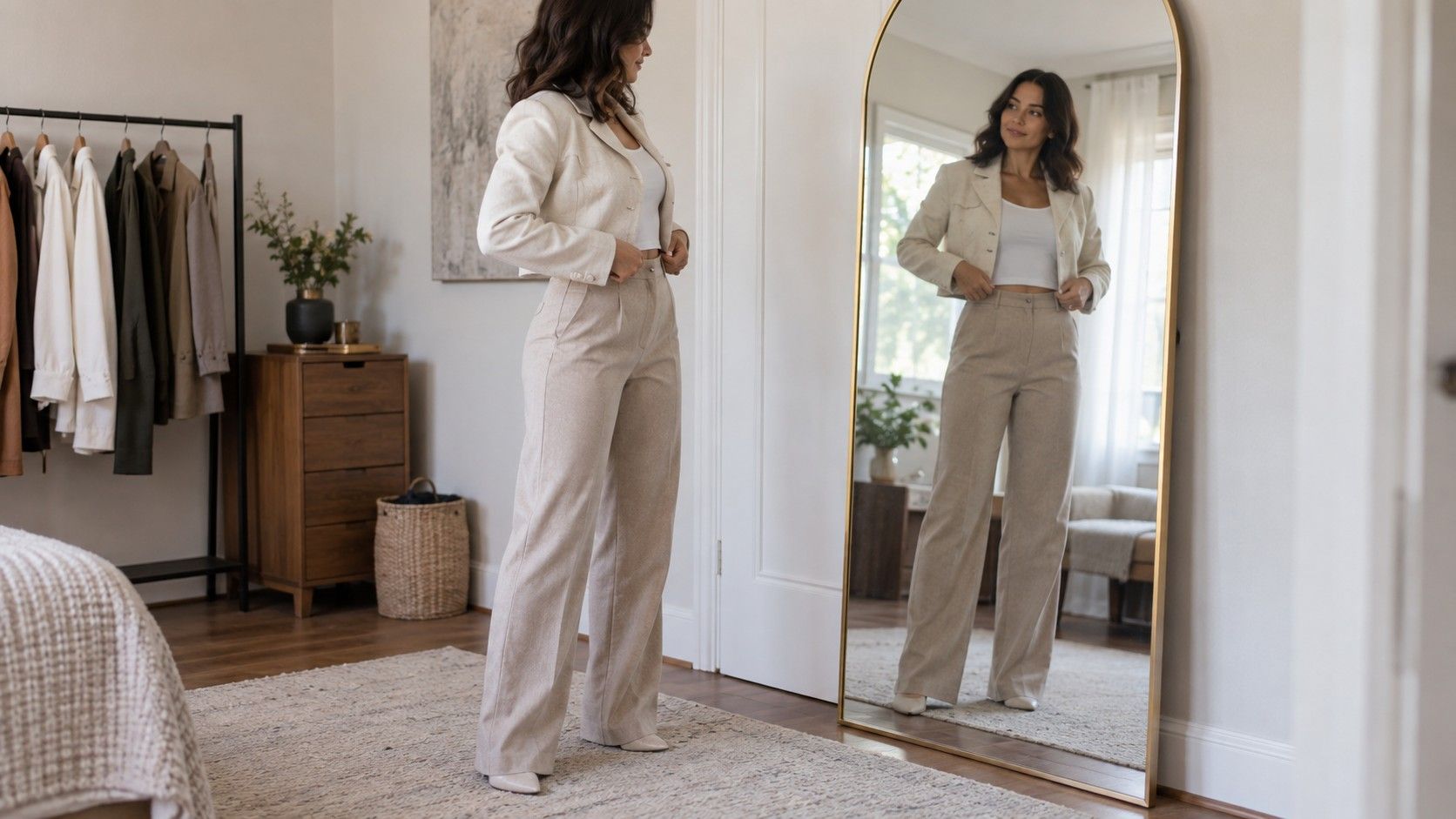
Having a longer torso and a shorter leg line does not dictate a style identity. It simply explains why a waistband, top, or jacket may land somewhere different on you than it does on a product model. Once you notice those landing points, getting dressed becomes less about following rules and more about choosing where an outfit begins, ends, and feels comfortable.
Check proportions without relying on a full-body photo
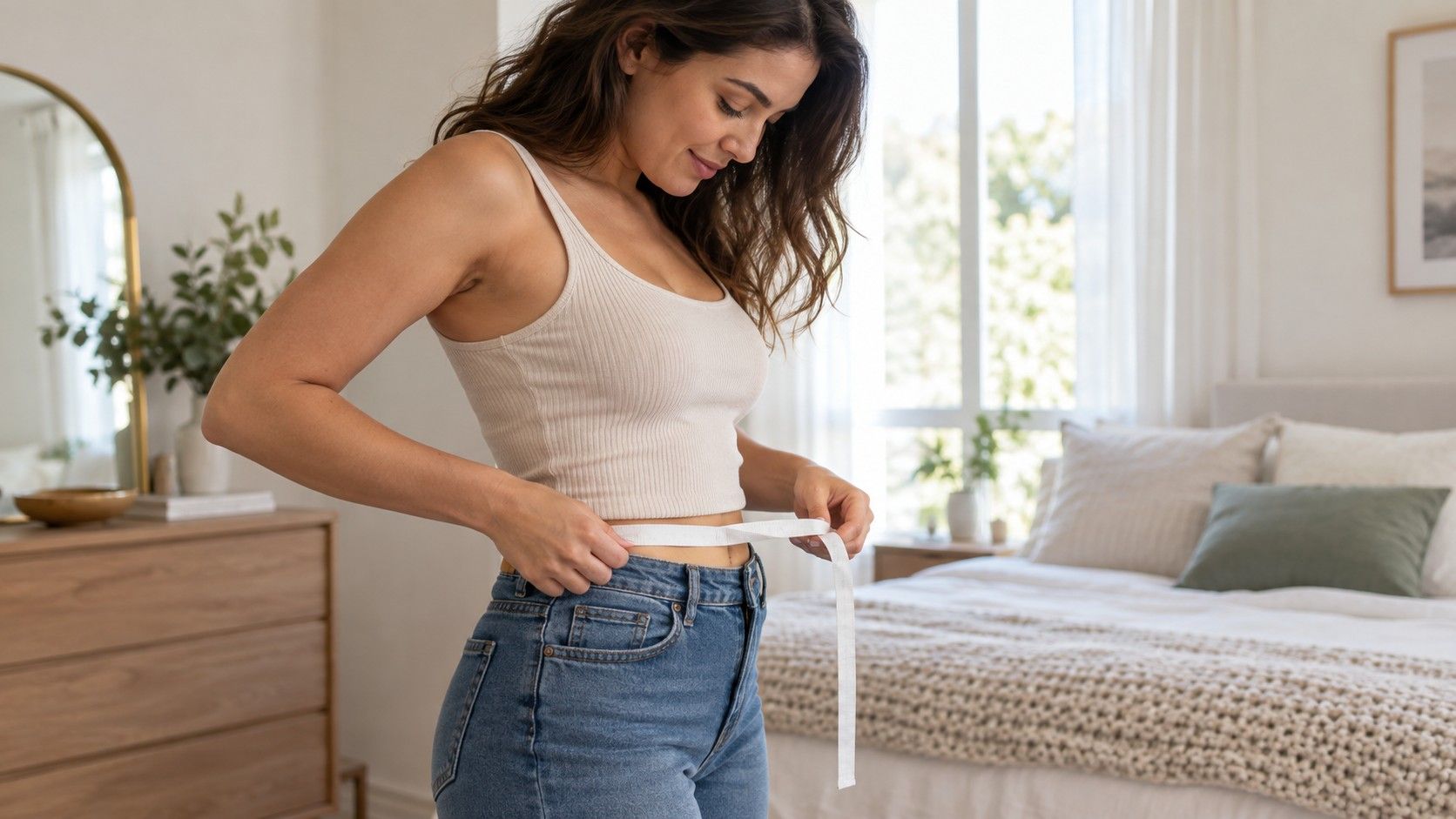
A mirror can suggest short legs body proportions, but photographs are easily distorted by camera height, lens angle, and stance. A more useful check starts with garments you already own. Put on trousers that stay in place without a belt and notice where the waistband sits relative to your natural waist, the narrow or folding point you feel when you bend sideways. Then observe the distance from that waistband to the shoulder and from the waistband to the floor.
You do not need to turn those distances into a body label. The comparison is enough. If tops often seem shorter than their listed length while standard-rise trousers still look low on your frame, torso length is probably influencing the fit. If trouser hems regularly need shortening even when the hip and waist fit well, the inseam is another practical clue. Neither observation says anything about the size or shape of your hips, waist, or shoulders.
For a repeatable measurement, place a soft tape at the crotch seam of a well-fitting pair of trousers and measure vertically to the top of the front waistband. That is the garment's front rise, not a measurement of your body. Also record the inseam from the crotch seam to the hem. These two numbers make online shopping more useful because labels such as high rise or ankle length vary widely between brands.
Do the check while standing naturally, then sit down. A waistband that looks well placed but presses into the ribs when seated is not a helpful starting point. Likewise, a very short top may create a proportion you like in the mirror yet require constant pulling during the day. Comfort and movement are part of the outfit, not an afterthought.
Choose trouser rise by where the waistband actually lands
Advice on how to dress a long torso often begins with high-rise trousers. They can be useful because raising the visible waist gives more of the outfit to the leg line, but the label alone tells you very little. On one pair, a 10-inch front rise may reach the natural waist; on another cut or size, it may stop below it. Check the rise measurement and the depth of the waistband rather than trusting the product category.
A broad, structured waistband usually creates a clear visual starting point for the trousers. A narrow elastic band produces a softer transition and may roll if it sits at a place where your torso bends. If you prefer a high placement, try sitting, climbing a step, and reaching forward in the fitting room. The waistband should remain stable without digging in or sliding toward the ribs.
Mid-rise trousers are not automatically unhelpful for long torso styling. A mid rise with a clean front, a close color match between top and trousers, and a shorter top can produce a continuous line without placing fabric high on the abdomen. This is especially useful if a high rise feels restrictive or if your natural waist sits close to the lower ribs.
The shape of the trouser leg changes the result too. A straight or gently tapered cut keeps the eye moving vertically when the hem is tidy. A wide leg can do the same when the fabric falls from the hip without collapsing into several folds. The useful question is not whether a cut makes legs look longer at any cost, but whether the waistband, crotch depth, and hem work together when you walk and sit.
Use top length and tuck placement deliberately
Top length determines how much of the trousers remains visible, so a difference of two or three inches can change the whole composition. A top ending near the waistband makes the trouser line easy to read. One ending at the fullest part of the hip divides the body lower down. Both can look intentional; they simply create different proportions.
If you like tucked tops, a full tuck gives the clearest waist placement. It works best when the shirt is not so long or bulky that excess fabric gathers below the waistband. A partial tuck creates a less defined edge and is useful when you want some movement around the hips. Check the side view: a front tuck that looks neat from the front can form a large fabric ridge at the back.
An untucked top can still suit long torso short legs outfits. Look for a hem that ends close to the top of the hip rather than automatically choosing the shortest option. Side splits, a curved hem, or a slightly boxy cut can provide room without adding a heavy horizontal band. If the top is longer, keeping it close in color to the trousers reduces the visual break.
Layers create another top length. A cropped jacket does not have to expose the waist; in practical terms, it may simply mean a jacket that finishes around the trouser waistband or upper hip. Wear it over a longer knit or shirt and compare the two visible hems. If they compete, either shorten the inner layer by tucking it or choose a jacket with a quieter, less rigid edge.
Pay attention to hems and the shoe line
Hem break is the fold created where trousers meet the shoe. Several deep folds make the lower leg line appear busier and can also catch under the heel. A slight break, a clean full-length hem, or a deliberate cropped hem is easier to read. The right choice depends on the trouser width and the shoes you actually wear, so bring the intended pair to an alteration appointment.
For full-length straight trousers, the front hem can lightly touch the shoe while the back stays clear of the floor. Wide trousers usually need enough length to hang vertically, but not so much that the fabric pools. Cropped trousers create a visible strip at the ankle. That break can feel fresh and practical, though it is stronger when the shoe color contrasts sharply with both skin and fabric.
The shoe line is not only about heels. A low vamp, the opening that shows more of the top of the foot, can extend the visible line below an ankle-length hem. A higher vamp, ankle strap, or boot creates a definite endpoint. If you enjoy that graphic break, use it. If you want a quieter transition, choose shoes close in value to the trousers or to the visible leg rather than searching for one supposedly correct style.
Soles matter in daily life. A platform or modest heel changes both height and the way trousers fall, but it also changes stride and comfort. Check the hem again with your everyday flat shoes. An outfit that depends on one uncomfortable pair rarely becomes a reliable part of a wardrobe.
Build combinations around real comfort
A simple fitting-room test is more revealing than a long list of style rules. Start with the trousers because their rise and hem are least flexible. Add two tops with different lengths, then one jacket. Take a front and side photo with the phone held around waist or chest height, not angled down from above. Move, sit, and put your hands in the pockets before deciding.
| Outfit element | Useful check | Alternative if it feels wrong |
|---|---|---|
| Trouser rise | Waistband stays comfortable when seated | Try a lower rise with a shorter or tucked top |
| Top length | Hem stays where intended while reaching | Use a partial tuck or a curved hem |
| Jacket | Closing it does not pull above the waistband | Try an open front or a slightly longer cut |
| Trouser hem | Fabric clears the floor and does not bunch | Alter for the shoes worn most often |
| Shoes | You can walk naturally for the full day | Match color values instead of adding height |
One dependable formula is a stable medium-to-high rise, a top ending at or tucked into the waistband, and trousers with a clean hem. Another is a tonal top and trouser combination under a jacket that ends near the upper hip. A third uses a longer relaxed top with slim or straight trousers and an uninterrupted shoe color. These are starting points, not obligations.
Print scale, color contrast, and fabric weight can have as much visual impact as torso length. A bold belt creates a strong waist marker; a matching belt blends into the trousers. Crisp fabric holds a defined edge, while soft fabric follows the body and shifts with movement. Change one element at a time so you can tell which detail actually improved the way the outfit feels.
Most importantly, keep the features you enjoy. Some people with a long torso prefer to emphasize that length with low-rise jeans, long layers, or a dropped waist. Others like a higher waist and a compact jacket. The goal is a repeatable understanding of placement: where the waistband sits, where the top ends, where the hem meets the shoe, and whether all three stay comfortable through an ordinary day.